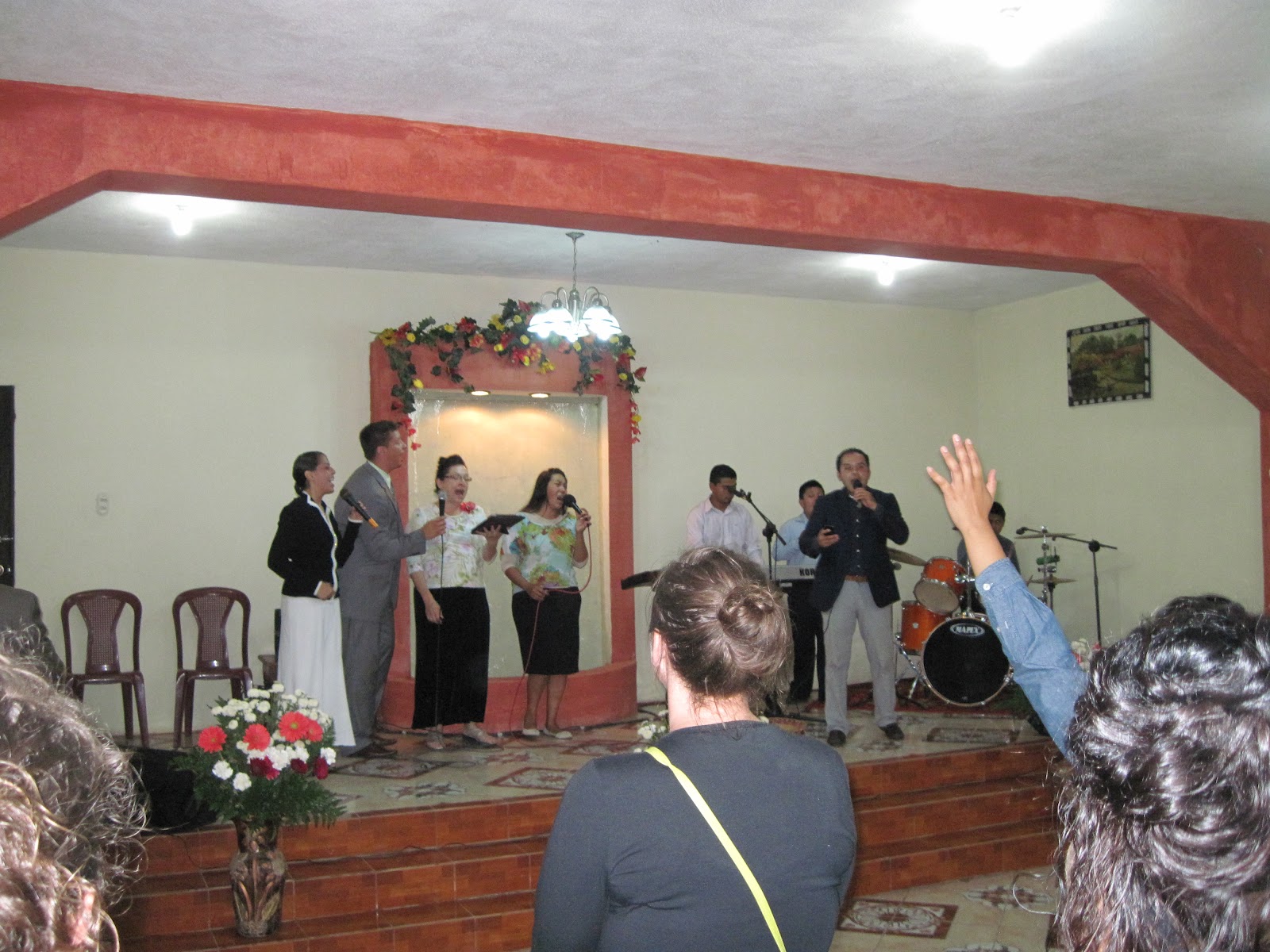
Photos from Day 6 in Guatemala...church in a village near Antigua, Guatemala.
Sunday, August 19, 2012
Saturday, August 18, 2012
~Guatemala 2012 - Let's Have Church
The following photos are of service in an Indian church on the way to Lake Atitlan in Guatemala. What a beautiful people...!
Tuesday, August 14, 2012
WD GMD 'Youth Impact Team' - Guatemala
Photos of the Western District Global Mission's Dept. 1st Annual 'Youth Impact Team' missions trip to Guatemala, Central America. Please enjoy! I will be updating daily, if possible, and there is internet available.
Today was a workday at the Bible School. We painted the stairwell from ground level to the fourth floor. A couple of the ladies worked on another project sorting clothes. I apologize for not having any pictures of that project. I will do my best to get some if they are available.
Flying to Guatemala on TACA (Bro. Nix from Nicaragua calls this the 'Take A Chance Airline')
The painting crew is ready to work
The women are anxious to get started...can you tell?
Joseph painting...
Bro. Tirso Gonzales...no blue paint on the white ceiling please...
Holly and Yesenia painting with brushes where we could not use a roller
Sis. Powell with a roller in one hand and a brush in the other...
Yesenia enjoying her work...
Trying to keep paint off the beautiful wood ceiling
After working hard you deserve a good hot meal
No job is finished until the clean-up is done...Holly is doing a great job
Finished! Now off too the hotel to clean up and then a good hot meal before bedtime
The ladies with Amber Corey, AIMer from Alabama
And then we were off to a well deserved shower and dinner with Sis. Lynne and Sis. Amber.
ZZZZZZZZZZZZZZZZZZZZZZZzzzzzzzzzzzzzzzzzzzzzzzzzzzzzzzz
The Flag of Guatemala
Tuesday, August 7, 2012
Tuesday, July 31, 2012
~Barcelona Commentary July 2012
| ||||||||||||||
Wednesday, July 4, 2012
We Are FREE! And must remain FREE!
INDEPENDENCE DAY - July 4th, 1776
Background:
Just a side note - one of my ancestors, John Hart, was a signer on the Declaration of Independence
HAPPY 4th of July EVERYONE! Have a great day!
"Blessed is the nation whose God is the Lord"
Psalm 33:12a
Background:
During the American Revolution, the legal separation of the Thirteen Colonies from Great Britain occurred on July 2, 1776, when the Second Continental Congress voted to approve a resolution of independence that had been proposed in June by Richard Henry Lee of Virginia declaring the United States independent from Great Britain. After voting for independence, Congress turned its attention to the Declaration of Independence, a statement explaining this decision, which had been prepared by a Committee of Five, with Thomas Jefferson as its principal author. Congress debated and revised the wording of the Declaration, finally approving it on July 4. A day earlier, John Adams had written to his wife Abigail:
The second day of July, 1776, will be the most memorable epoch in the history of America. I am apt to believe that it will be celebrated by succeeding generations as the great anniversary festival. It ought to be commemorated as the day of deliverance, by solemn acts of devotion to God Almighty. It ought to be solemnized with pomp and parade, with shows, games, sports, guns, bells, bonfires, and illuminations, from one end of this continent to the other, from this time forward forever more.
Adams's prediction was off by two days. From the outset, Americans celebrated independence on July 4, the date shown on the much-publicized Declaration of Independence, rather than on July 2, the date the resolution of independence was approved in a closed session of Congress.
Historians have long disputed whether Congress actually signed the Declaration of Independence on July 4, even though Thomas Jefferson, John Adams, and Benjamin Franklin all later wrote that they had signed it on that day. Most historians have concluded that the Declaration was signed nearly a month after its adoption, on August 2, 1776, and not on July 4 as is commonly believed.
In a remarkable coincidence, both John Adams and Thomas Jefferson, the only signers of the Declaration of Independence later to serve as Presidents of the United States, died on the same day: July 4, 1826, which was the 50th anniversary of the Declaration. Although not a signer of the Declaration of Independence, but another Founding Father who became a President, James Monroe, died on July 4, 1831, thus becoming the third president in a row who died on this memorable day. Calvin Coolidge, the 30th President, was born on July 4, 1872, and, so far, is the only President to have been born on Independence Day.
Just a side note - one of my ancestors, John Hart, was a signer on the Declaration of Independence
HAPPY 4th of July EVERYONE! Have a great day!
"Blessed is the nation whose God is the Lord"
Psalm 33:12a
Tuesday, June 26, 2012
~Ethics and Integrity in LEADERSHIP
****************************************
LEADERSHIP and INTEGRITY
"...faithful leaders will seek to keep their word. Every time they break their word, something tends to die in their organizations, in the wider culture, in their followers, and in themselves. Faithful leaders will not make light use of their own shifting goals in excusing themselves from fulfilling their responsibilities. They will seek to honor their promises as much as possible despite altered circumstances. Even when they have legitimate reasons to break their promises, they will look for some way to partially honor their pledges."
- from the book 'FAITH in LEADERSHIP' by Robert Banks/Kimberly Powell
Promises
"Over a period of time, the leaders of organizations will tend to make a range of promises to those who work with and for them. These promises may be large or small, explicit or implicit, personal or collective, strong or weak. Like many politicians' promises, these may be met with skepticism; as many cultural critics have lamented, there seems to be a growing disparity, in private as well as public life, between the promises that leaders and institutions make and the promises that they keep. This disparity is due in part to the changing definition of what a promise is: nowadays, most people seem to regard a promise as the expressions of a hope rather than as the creation of an obligation. The disparity is also due to the move away from a principle-based ethic and toward a situational, fulfillment-oriented one whereby it is enough, in order to break a promise, to say that external circumstances or personal aspirations have changed."
-from the book 'FAITH in LEADERSHIP' by Robert Banks/Kimberly Powell
INTEGRITY!
In the Bible, words translated as integrity do not appear with great frequency. When they do they are very instructive.
The heaviest concentration of such occurrences appears in the so-called wisdom literature of the Old Testament - for example, "The INTEGRITY of the upright guides them, but the crookedness of the treacherous destroys them" (Proverbs 11:3). Here, the implication is that INTEGRITY contributes to one's success. Even if INTEGRITY brings no financial reward, scripture insists, "Better the poor walking in INTEGRITY than one perverse of speech who is a fool" (Proverbs 19:1). Presumably, then, INTEGRITY has something to do with plain speaking.
In the Psalms, INTEGRITY is often used as a parallel word for righteousness or uprightness (for instance, see Psa. 7:8, 25:21). Psalm 26 uses the word twice: "Vindicate me, O Lord, for I have walked in my INTEGRITY" (Psalms 26:1), and then, after pointing to a contrast with "those in whose hands are evil devices, and whose right hands are full of bribes," makes the plea "But as for me, I walk in my INTEGRITY; redeem me, and be gracious to me" (Psalms 26:1). According to Kidner (1973, p. 118), the basic meaning of the word INTEGRITY is "wholeness, usually in the sense of whole-heartedness or sincerity, rather than faultlessness."
-from the book 'FAITH in LEADERSHIP' by Robert Banks/Kimberly Powell
~What are the implications for LEADERSHIP?
There is no doubt that the Old Testament depicts God as looking, often in vain, for the highest standards of INTEGRITY in Israel's leaders. In particular, they are expected to seek after the welfare of their people rather than after their own needs. Great leaders in the Old Testament, such as Nehemiah and Daniel, display their INTEGRITY by refusing to lower their standards or betray their convictions in the face of pressure and opposition.
-from the book 'FAITH in LEADERSHIP' by Robert Banks/Kimberly Powell
Subscribe to:
Posts (Atom)